AI and Art: What It Is, What It Does, and What Collectors Need to Understand
AI has become one of the most disruptive forces in contemporary visual culture, but much of the public discussion still misses the point. It is often framed as either a threat to artists or a novelty tool for generating images on demand. For collectors, neither framing is particularly useful.
What matters is not whether AI replaces art, but how it is changing the structure of artistic production, authorship, and ultimately value.
For collectors, this is not a technical debate. It is a market shift.
What AI actually is (and what it is not)
When people refer to “AI art,” they are typically referring to generative models—systems such as Stable Diffusion, Midjourney, or DALL·E—that produce images based on text prompts.
These systems are trained on vast datasets of images and language. They do not “imagine,” “intend,” or “create” in the human sense. Instead, they statistically predict visual outcomes based on learned relationships between words, forms, styles, and compositions.
This distinction is critical for collectors.
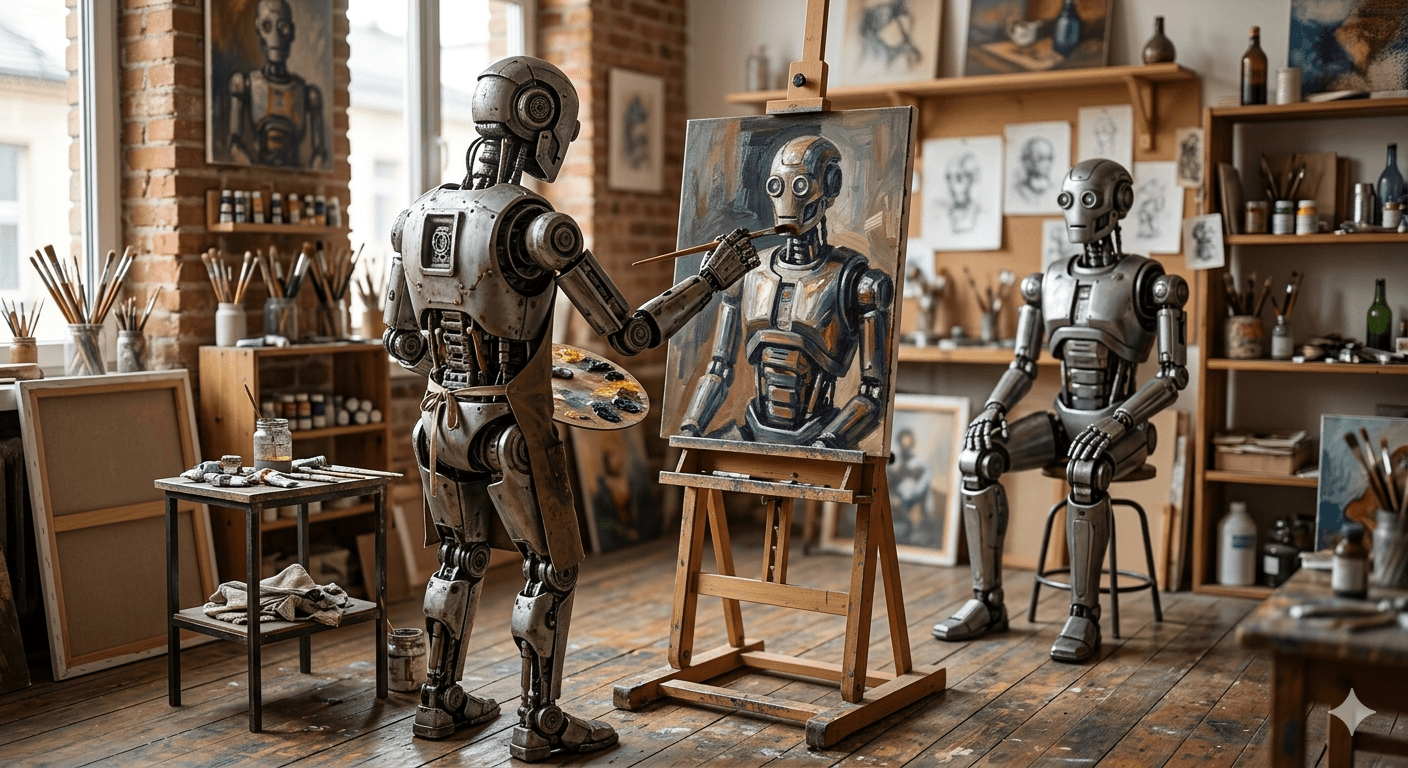
AI is not an artist. It is a production system for visual probability.
That means it can generate images that resemble intention, style, and authorship—without possessing any of them. What you are seeing is not expression, but recombination at scale.
What AI changes in the production of art
Historically, artistic value has been tied—at least partially—to labor, time, and technical difficulty. AI disrupts this equation.
It dramatically reduces the cost of visual exploration. What once required hours of sketching, iteration, or studio experimentation can now be generated in seconds.
In practical terms, AI can:
- generate entire image worlds from prompts
- produce rapid variations of a single idea
- alter composition, lighting, or style instantly
- blend multiple visual languages into hybrids
- support early-stage concept development across painting, design, film, and installation
Increasingly, AI is not used to “finish” artworks, but to explore directions before human refinement begins.
This matters because it shifts where effort sits in the process. Execution becomes cheaper. Selection becomes more important.
How contemporary artists are actually using AI
Despite popular narratives, most serious artists are not replacing their practice with AI. They are integrating it into existing workflows.
In practice, AI tends to sit at the beginning of the process:
Artists generate large bodies of visual material quickly, using them as expanded sketchbooks rather than finished works. From there, they:
- paint over or rework selected outputs
- translate AI compositions into traditional media
- reconstruct images in 3D or physical materials
- combine multiple generated sources into a single resolved piece
- use AI only for secondary layers such as background or texture
In this sense, AI functions less as a creator and more as a generator of possibilities.
The artist’s role shifts from manual production toward editing, selection, and control of direction.
For collectors, this creates an important distinction: AI involvement does not automatically define the artwork. The degree of human intervention does.
What this means for value in the art market
The most important structural change is not aesthetic—it is economic.
AI introduces abundance into image production. High-quality visuals are no longer scarce. They can be generated at near-zero marginal cost.
This does not eliminate value in art. It relocates it.
In an environment of visual abundance, value concentrates in:
- authorship and identity
- conceptual clarity
- curatorial judgment
- provenance and intent
- institutional framing
- scarcity of meaningful decision-making
In other words, the market shifts from valuing production to valuing selection.
For collectors, this is significant. It suggests a future in which technical execution alone carries less weight, while clarity of artistic position carries more.
The emerging categories collectors should be aware of
AI is already producing distinct strata of artistic output:
- Fully generated imageryHigh-volume, low-cost images with minimal human intervention. These are abundant and function more like visual content than collectible works.
- Hybrid studio worksAI is used for ideation or structure, but the final work is materially or manually resolved by the artist. This is currently the dominant gallery-accepted model.
- AI-native practicesWorks where the system itself is part of the artwork—generative environments, evolving visuals, or algorithmic systems that produce ongoing output.
From a collecting perspective, only the latter two categories are currently entering serious institutional dialogue, and even then selectively.
How galleries and institutions are responding
The gallery system is still in a cautious phase.
Internally, AI is already widely used—for writing, research, marketing, and visualization. But its role in exhibitions remains inconsistent.
The hesitation is not purely technological. It is structural.
Galleries rely on clear frameworks of:
- authorship
- artistic intent
- labor and process
- scarcity of production
AI complicates each of these.
As a result, most galleries currently adopt a hybrid stance: AI is acceptable when it is clearly embedded within a human-led practice, but less accepted when it functions as the primary generator of the work.
At the same time, a longer historical pattern is emerging. Previous technologies—most notably photography—were initially excluded from fine art discourse before eventually becoming central to it.
AI is likely undergoing a similar transition, but at a much faster pace.
The real shift for collectors: from object to position
For collectors, the most important implication is not technical—it is strategic.
When production becomes inexpensive and widely accessible, the defining question is no longer “how was this made?” but:
Why does this work matter within a saturated field of images?
This shifts collecting away from material scarcity alone and toward:
- clarity of artistic position
- strength of conceptual framework
- institutional trajectory
- consistency of practice across mediums
- ability to define meaning in excess rather than scarcity
In other words, collecting becomes less about rarity of output and more about rarity of vision.
Conclusion
AI does not remove artists from the equation. It removes one of the historical constraints of art: the cost and time of production.
What remains is a more selective layer of practice—one defined by decision-making rather than execution.
For collectors, this is the key shift.
The future art market will not be divided between human and machine-made works. It will be divided between works that merely generate images, and works that successfully define why those images matter.
In a system where everything can be made, the only enduring scarcity is meaning.