Xochi Magazine.
Collector Insight: Untitled Mixed Media Relief by Roger Remaut
Author
Luc Levez
Published
Mar 2026
Share
Roger Remaut — Untitled Mixed Media Relief
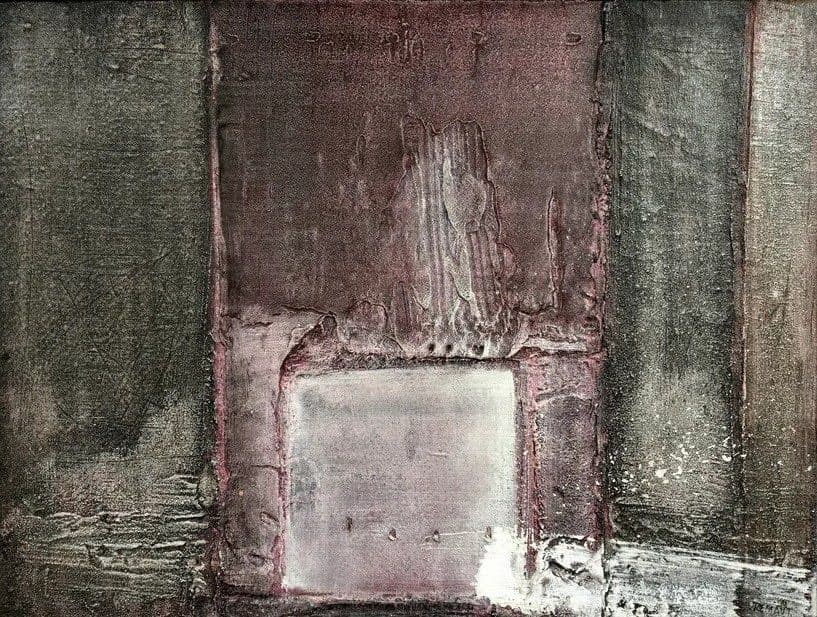
In this untitled mixed media relief, Roger Remaut extends his investigation of abstraction as a materially driven and process-oriented field, where image, object, and surface operate as a continuous condition rather than separate categories. The work occupies a threshold between painting and relief construction, asserting itself less as a representation than as an accumulated event—built through layering, abrasion, and selective erasure.
What unfolds is not a static composition, but a durational surface: one that registers time as physical evidence. Light activates its uneven topography, shifting the work between legibility and dissolution as the viewer’s position changes. In this sense, perception is not passive but implicated in the work’s continual reconfiguration.
Material Logic and Surface Construction
Remaut’s process is grounded in the slow accumulation and disruption of material. Acrylic and mixed media layers are repeatedly applied and worked back, producing a surface that carries its own history of construction and revision. Rather than concealing process, the work exposes it as structural content.
A vertical organisational logic introduces a provisional architecture within the field. However, this structure remains unstable: edges fracture, surfaces are eroded, and internal strata are revealed through acts of removal as much as addition. The work resists coherence, instead sustaining a productive tension between order and dissolution.
Within the upper central zone, abrasion intensifies, exposing underlying layers and reinforcing the sense of a surface in continual negotiation with its own making. Across the composition, density accumulates unevenly, with heavier material deposits toward the lower register and more dispersed interruptions throughout the field.
A pale, squared form near the lower centre introduces a distinct spatial interruption. Unlike the surrounding flux, it presents a condensed and comparatively resolved surface. Yet rather than functioning as resolution, it operates as tension—embedded within the field while simultaneously setting itself against it. It interrupts continuity without stabilising hierarchy.
From Observation to Translation
The origins of the piece lie outside the studio, in the artist’s observation of a graffiti-covered wall in Quimper, France. Importantly, it is not the graffiti imagery itself that carries into the final work, but the structural logic of the surface—layering, interruption, erosion, and accumulation formed over time.
During this initial encounter, Remaut produced a sketch of the selected section of the wall. This drawing functions as a transitional device rather than a representational study: it records key structural relationships, rhythms, and spatial tensions that later inform the construction of the work. The sketch operates as an index of selection and emphasis, isolating the compositional principles that would be translated into a materially constructed abstract field in the studio.
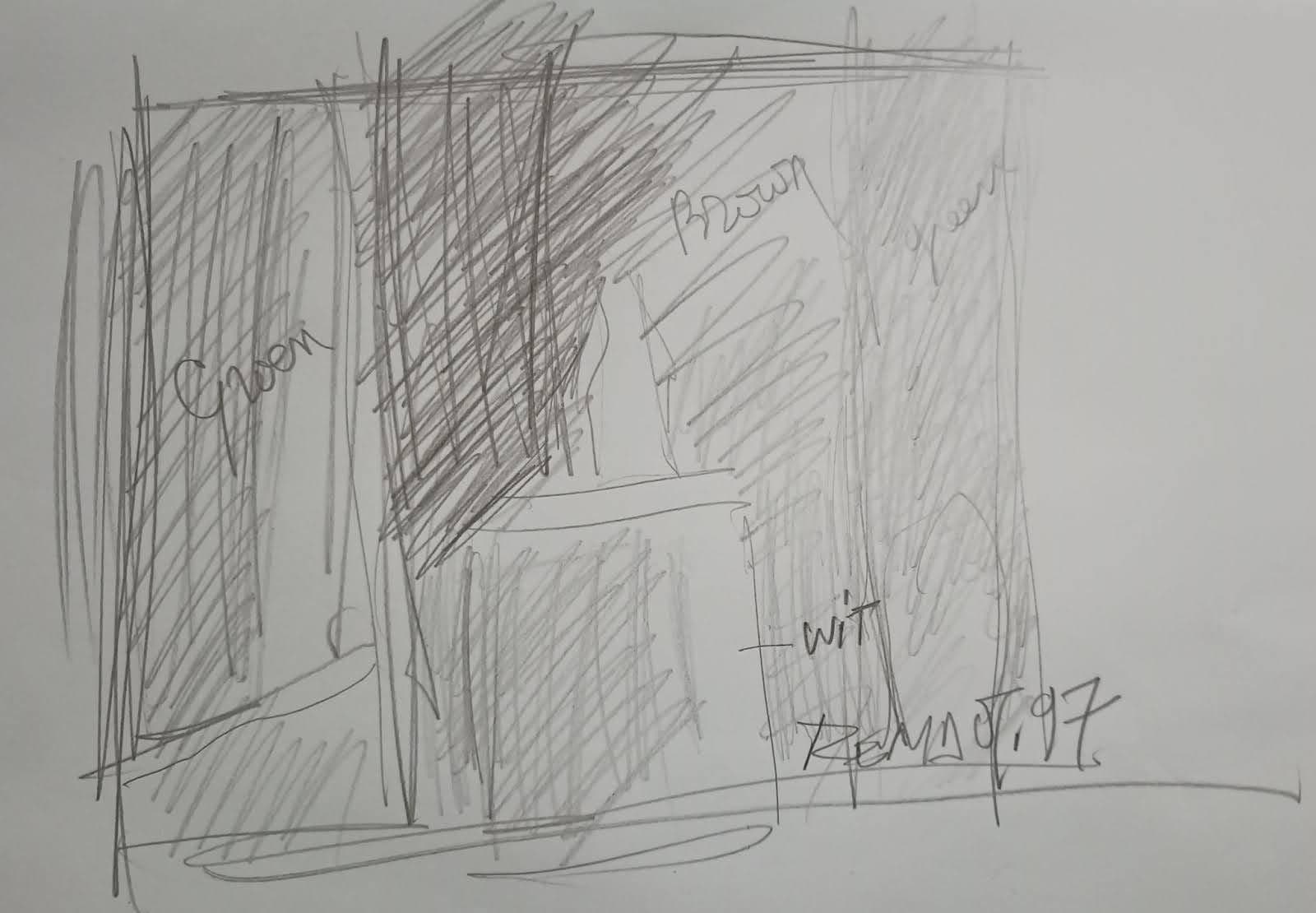
From this point, observation is progressively distilled and reconfigured into an autonomous visual language. The drawn notation is not reproduced, but transformed—becoming a set of structural decisions concerning division, density, and surface behaviour.
For Remaut, the objective is not depiction but translation: a shift from observed environment to embodied material process. Texture becomes structure, and structural relationships become the foundation for abstraction. This grounding in a specific real-world surface provides a conceptual anchor, while simultaneously enabling the work to move fully into a non-representational condition shaped by form, material, and process.
Norwich Film and Multimedia Festival — Curatorial Context
The work was selected for presentation at the Norwich Film and Multimedia Festival, a curated international platform dedicated to experimental film, multimedia practice, and expanded forms of visual art. The festival is recognised for bringing together artists working across moving image, installation, digital media, and interdisciplinary practices that challenge conventional distinctions between painting, cinema, and spatial experience.
Selection is made through a curatorial review process that evaluates works in terms of conceptual rigour, formal innovation, and their contribution to contemporary debates surrounding image, duration, and perception. Rather than functioning as an open exhibition platform, the festival operates as a curated environment in which works are chosen for their dialogue with one another and their relevance to evolving media-based practices.
Within this context, inclusion signals recognition of the work’s relevance to expanded fields of abstraction—particularly where material processes intersect with time-based thinking and spatial articulation. The programme frames selected works within a shared investigative space, where the moving image is understood not only as screen-based output, but as part of a broader continuum of perceptual and material practices.
For Remaut’s practice, this context is significant in that it positions a materially constructed relief within dialogue with time-based and multimedia works, reinforcing abstraction as a transversal field that extends beyond traditional painting into interdisciplinary territories.
Residual Form
What remains is a surface that does not resolve into image, but holds itself in a state of ongoing formation. The work is sustained by its own procedures—accumulation, interruption, and removal—each leaving visible traces that resist closure.
Across its material field, structure and instability operate in tandem. Order is suggested, then undone; coherence is approached, then displaced through erosion and reworking. In this oscillation, the relief maintains its condition as a negotiated space rather than a fixed statement.
The work ultimately exists within this interval—between construction and dissolution, between observation and translation—where abstraction is not presented as an outcome, but as a continuing act of becoming.
Never miss a Feature.
Exhibitions • Interviews • News
Est. 2024